
A critical primer on the redevelopment of the Waterloo estate

In the last few days, housing activists in Sydney occupied part of the Waterloo public housing estate. Organised by Action for Public Housing, they want to stop the demolition of 150 homes—the first stage of the redevelopment of Waterloo South. So far the story has been covered by the ABC, South Sydney Herald, Honi Soit and Newscorp.
I’ve researched the Waterloo estate redevelopment for more than ten years. It was the subject of my PhD research between 2016 and 2020. I’ve written about it across various academic papers, Conversation articles and op-eds. I was also involved in the Waterloo Public Housing Action Group from 2016 to 2018 and Action for Public Housing from 2021 to 2024. This is my primer on the Waterloo estate redevelopment and the major problems with the current plans.
What is happening to the Waterloo estate?
The Waterloo estate is a 2,012 home estate of around 17ha in the north-west corner of the suburb of Waterloo. It was built over several decades, the earliest homes in the 1940s and most recent in the 1980s. It includes two 30-storey towers (Matavai and Turanga) and four 16-storey slab buildings (Cook, Banks, Solander and Marton). These six buildings—1,263 apartments—make up the ‘Endeavor estate’, completed in the 1970s. More recently, they have been labelled Waterloo North and Waterloo Central.
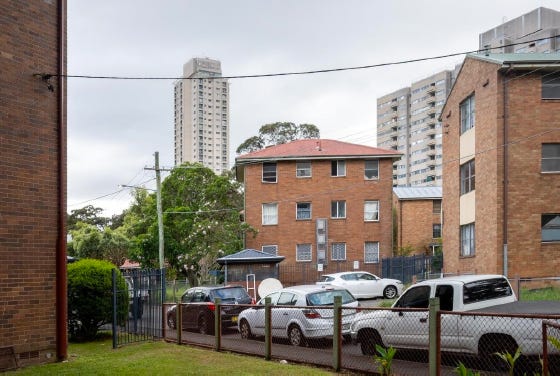
The rest of the estate is a mix of walk-up and mid-rise apartment buildings, including the first public housing built on the estate but also the most recent. These 749 homes, across two-thirds of the total area of the estate, are what make up Waterloo South. This is the part of the estate currently undergoing redevelopment; the future of Waterloo North and Central is unclear.
Homes NSW delivered relocation notices to 150 Waterloo South households in March 2025, meaning that tenants would be forced to move to another public or community housing dwelling. Another 99 received relocation notices in April 2026. Of these, 70 moved to new social housing above the Waterloo Metro station. The remainder moved, or will move, to other vacant public or community housing dwellings. Tenants are supposed to be offered suitable homes in their local area, or an area where they would otherwise like to live, but vacancies are rare and Homes NSW typically provides just two offers.
The current plan for Waterloo South is to demolish all public housing and build 3,300 new homes. Of these, 30% will be social (community) housing. Another 20% will be affordable housing, but two-thirds of this figure can be sold after 25 years and no information has been provided on rent setting (affordable housing in NSW can be up to 80% of market rent). The remaining 50% will be privately owned, market-rate housing1. The project will be delivered by a consortium led by Stockland and involving community housing providers Link Wentworth, Birribee and City West.
How did we get here?
While no ground has been broken or bricks laid, the redevelopment of the Waterloo estate has already had a long and complicated history, with the first plans drawn up in the early 2010s. Both the Waterloo and Redfern estates were within the ambit of the Redfern Waterloo Authority, the government agency established to ‘revitalise’ Redfern-Waterloo in 2005 as part of the Carr government’s response to the so-called Redfern Riots. Yet the RWA’s draft plans for the estates, released in 2011, didn’t align with those of the Land and Housing Corporation (now within Homes NSW), and the RWA was dissolved shortly thereafter.
Plans re-emerged in December 2015 as part of the Baird government’s Communities Plus program. Like other Communities Plus projects, Waterloo was selected because of its high land value, which could be capitalised to fund the replacement of public housing at no cost to the government. Land value was further enhanced by the construction of the Waterloo Metro station. The Sydney Morning Herald reported that redeveloping the estate was the decisive factor in a cabinet vote on the station’s location. Brad Hazzard, then Minister for Social Housing, notified tenants of this ‘exciting’ opportunity in December 2015 and indicated that relocations would begin in mid-2017.
The Coalition’s plan for Waterloo was for 7,000 new homes, with 28% community housing, 7% affordable housing and 65% private housing. A lengthy community consultation and engagement process unfolded over 2016 to 2019, ultimately producing three masterplan options that differed in urban design but not density or tenure mix. Following further consultation, a preferred masterplan was released in January 2019. In response, the City of Sydney—which had been critical of the proposed density, design and tenure mix—released an alternative masterplan. A protracted dispute unfolded between the City and LAHC, with planning authority briefly returning to the City. It was here that LAHC decided to split the estate into three: Waterloo South would progress through the planning process while Waterloo North and Central were put on hold.
Plans for Waterloo South were approved and tendered in the second half of 2022, incorporating some of the City’s urban design work but sticking to LAHC’s tenure mix. NSW Labor’s 2023 election victory changed things slightly. While the tender process was underway, the Minns government announced that Waterloo South would be 30% community, 20% affordable and 50% market housing. They also agreed, in response to the Redfern Waterloo Aboriginal Affordable Housing Campaign, to devote 15% of the community and affordable housing to Aboriginal housing.
The Minns government can therefore claim to have improved the previous government’s plan for the estate, adding an extra 100 or so community housing units and more than 400 affordable housing units (albeit only for 25 years and likely to be leased at 75-80% of market rents). Yet these are very modest improvements. The Waterloo community and wider public deserved more, particularly given commitments Labor made both before and after the election.
In opposition, local Labor MP Ron Hoenig labelled the project ‘social cleansing’ and a ‘smokescreen’ to privatise public land. The 2022 NSW Labor State Conference adopted a motion binding the NSW Labor Parliamentary Caucus to “a moratorium on the privatisation of public housing, including the sale, outsourcing, or leasing of any public housing assets or services”. Over 2022 and early 2023, Rose Jackson, then Shadow and now Minister for Housing, attended Action for Public Housing rallies at both Waterloo and Sydney Town Hall and criticised the Coalition’s plans for the estate. During the election campaign, Hoenig sent tenants a letter titled ‘Tell the Liberals “Hands off Waterloo”’, claiming that by voting Labor they had “the opportunity to stop the sell-off of the Waterloo Public Housing estate and protect your home”. A text message was sent to the same effect in the days before the election. In May 2023, Chris Minns announced a ‘freeze’ on the privatisation of public housing via social media. Yet the next month his government announced that it was proceeding with the Waterloo South project under only slighly improved parameters.
Redevelopment myths and realities
Bewilderingly, both the Premier and Housing Minister have denied that transferring more than half of Waterloo South into private ownership constitutes privatisation. This is just one of several tendentious claims that have been made to justify redevelopment, by governments of both stripes.
One of the more easily debunked is that redevelopment is a solution to social problems on the estate. There is a widely held view that mixed tenure developments like Waterloo South improve social outcomes for people in social housing. Brad Hazzard espoused this view when making the case for redevelopment in 2016, claiming that a more mixed development would reduce antisocial behaviour and inspire tenants to become upwardly mobile. The sentiment was recently repeated by Jackson, who claimed that Waterloo is not a “functional community”.
Yet as I have written here (and Alan Morris and colleagues here), there is very limited evidence that spatial interventions like redevelopment can solve social problems like poverty or antisocial behaviour. In any case, social mix is more meaningfully calculated at a neighbourhood rather than project level, and there is certainly no evidence that 30% social housing is the socially optimal proportion.
The main argument that the current government makes is that redevelopment will improve the quality and quantity of social housing. This is partially true, but the argument is not as strong as it might first seem. While there will be a 32% increase in social housing within the boundaries of Waterloo South, the uplift over the estate as a whole (should the Minns government continue it’s predecessor’s plans) will be much smaller. Waterloo Central and North are denser and have less room for growth: they make up about one third of the estate’s area but two thirds of its housing. Capping social housing at 30% of Waterloo South has therefore severely limited the potential for more social housing across the estate as a whole. Capping social housing at 30% in the redevelopment of North and Central would mean a net loss of social housing on those sites and only slighlty better than breakeven across the whole estate.
There’s also a question of when new social housing becomes available. Estate redevelopment causes significant strain on the social housing system, because homes are lost to demolition in the short- to medium- term and sitting tenants move into vacant dwellings that could otherwise be offered to applicants on the waiting list. I analysed such impacts on social housing supply in this paper, finding that the ‘payback’ from redevelopment—in terms of the net gain of nights of accomodation—can take decades to arrive. While redevelopment may eventually produce a larger quantity of homes, there’s a significant loss of capacity to house low-income people over the period of relocation, demolition and construction.
Redevelopment should improve housing quality; some of Waterloo’s homes are 60 to 70 years old and public housing in general is poorly maintained. But this is not to say that they are beyond repair. No condition assessment has been made public, nor any refurbishment feasibility study. Using original architectural plans, we found that most buildings in Waterloo perform fairly well against NSW’s current Apartment Design Guide. Given the strain that redevelopment places on the social housing system, the focus should be on replacing the worst quality homes in NSW and building as much as possible without demolitions.
The core problem with the redevelopment of the Waterloo estate, and most others, is that the process is not primarily driven by concerns about social housing quality, quantity, or outcomes for tenants. Waterloo was selected because it is highly coveted real estate. Land values were high enough for the project to go ahead with no net loss of social housing and no (or minimal) cost to the NSW Government, while advancing a state-led gentrification agenda for the wider neighbourhood that dates back to the early 2000s.
Rethinking redevelopment
Most public housing in Australia is at least 40 years old. It has been badly neglected and, in some cases, badly built. This is a reality of Australia’s housing system that needs to be reckoned with. However, alternative approaches to redevelopment are possible.
Firstly, rather than being invited into superficial consultation and engagement processes, tenants should be empowered to decide whether and how redevelopment proceeds. Resident ballots are one mechanism for this, if they are binding and independently administered and resourced. Ballots in London have led to better, rather than fewer, projects going ahead.
These better projects also include refurbishment and retrofits. In Australia, OFFICE has led several design and feasibility studies for retrofitting public housing, including for Waterloo North and Central. The Retain, Repair, Reinvest: Waterloo North and Central project found that refurbishment and infill offered significant cost savings as well as social benefits from minimising the impact of relocations, while also adding to housing supply. Where demolition and redevelopment does occur—and we should accept that in some cases it should—then relocations and construction should be staged so that tenants move directly into new homes. Minimising the individual impacts of relocation and the impact on social housing supply should be the priorities.
The current model precludes these priorities, and a different model requires a different political economy of social housing—a topic I’ll be writing about here over the next few months.
The precise numbers have been inconsistent, with social housing figures ranging from 900 to 1,050 and affordable housing from 600 to 700. They are liable to change over the course of the project, based on previous estate redevelopment projects.